"I don't do green." That was my father's response. I had planned to bake him a treat for father's day, and, knowing that he hates surprises, I asked him ahead of time what he would want. The decision - cookies. The victim - environmentalism?
I buy as high a percentage of organic foods as my budget allows, so most of my food is organic, all natural, or has some other environmentally friendly aspect, such as rain forest alliance certification, fair trade, locally grown, free range, no preservatives or artificial ingredients, etc. So I explained to him that any baked good he received from me would be as green as possible without any effort on his part.
I have to buy my own groceries because my parents refuse to "go green". My dad has some sort of superiority complex when it comes to socially and environmentally responsible, healthy foods. I think he reads my grocery independence as a declaration of self-righteous pomp. It's patrially true: I can't eat fast food and meat from tortured animals; my conscious won't allow it. I prefer to support families instead of corporations. I don't want pesticides and synthetic chemicals in my body, in the earth or on my mind. So I made up my own mind and took responsibility for myself. I don't know why it irritates him so much. What does that even mean? to not "do" "green"? What does it take to convince people to "do" what is simultaneously better for themselves and for the earth, and therefore for their children and grandchildren? It baffles me that people can be so adamantly against something that is harmless to them. It's not like my dad benefits financially from maintaining an unjust system (as many people do).
I want to show him the documentary Renewal. Maybe that will touch his religious side and convince him that there is merit in the environmental movement. I have to learn to speak to people in their own language. We shall see.
Monday, June 29, 2009

Tuesday, June 23, 2009
Wednesday, April 29, 2009
Huffington Post Review: Obama's First 100
Today, The Huffington Post published an article re: environmental progress in Obama's first 100 days as president. It is aptly entitled "Obama: Clearing the Air in 100 Days" (by Dan Becker and James Gerstenzang).
Few who care about revolutionizing how human beings impact the environment can deny that Obama is a godsend compared to George W. Bush, whose career goals didn't particularly mesh with those of "environmentalists."
The article points to the EPA's declaring global warming a "threat to public health," so that "the federal government can use the Clean Air Act to cut greenhouse gas emissions."
It emphasizes Obama's apparent devotion to creating green collar jobs, uniting environmentalism and the workforce, "Central elements in the American economy that had been at war for decades."
By increasing efficiency standards, reviewing Bush's decision to prevent 13 states from cutting emissions, and by showing "the biggest polluter--the auto industry and utility companies--that he is serious," Obama is bound to save the world.

Maybe I'm a bit dramatic. I suppose the only part of the article that irked me was this:
"The U.S. Agency for International Development supports efforts to improve lives across the developing world--including places where cars and electricity are rarities but where twig- and dung-burning stoves emit tons and more tons of black carbon into the atmosphere, increasing global warming. The agency could send $20 solar-powered cooking stoves to villages in Africa and Asia."
As an anthropologist in training, that statement "improve lives across the developing world" is unsettling. What does it mean? Will sending cheap solar-powered cooking stoves improve the lives of African villagers? Or does it serve to ease the conscious of the highest polluting countries, a symbol of aid and sympathy that allows us to ignore all of the other things that developed countries do to keep developing countries in this position?
Must villagers change their traditions even though it is we Americans who have contributed significantly more to this global crisis?
What will having them import foreign products do for their economic and political position? for their relationship to local materials and resources? I don't see it improving it, and I do think that's an important consideration.
How will these $20 stoves be made? by whom? where? with what materials? If you're selling it for $20, what is the production cost? Changing the efficiency won't change the fact that a product is mass produced or exported, which has a lot of environmental implications, especially for labor conditions, materials and transport methods. It is reasonable to question this. The cheapest commodities usually have roots in questionable labor and environmental practices.

I am not against solar power, reduced emissions or higher efficiency. Obama's actions show a change from Bush. Is it progress? Of course. But, does it show a change in environmental thought? I just don't see his plan as particularly comprehensive, nor do I feel it to be as revolutionary as this article makes it sound.
It operates within the same general framework and political economy that sets up these power dynamics between developed and developing countries in the first place. No, I don't expect Obama to revolutionize the political economy (although he sure made out like that was his goal.)
The article doesn't mention Obama promoting attitudes about "the environment" as an issue of natural resource access/property relations, as an issue of racism and inequality, as a serious human health issue (Swine Flu!), which would be real change.
It touches on jobs, which is great, but it doesn't touch on the politics of food production and how factory farms are subsidized by the US government and our tax dollars. It doesn't discuss how industrial and chemical plants, and other environmentally hazardous industries, are disproportionately placed in minority neighborhoods, the neighborhoods of people with a weaker political and economic voice. It only seems to address issues of consumerism while ignoring the sociocultural constructs that allow these patterns.
It has a very top-down approach to "cleaning the air." Then again, he is the POTUS, so I don't know how he could do otherwise.
"The Climate won't wait..." Neither should Obama, and neither should we. I just think there are a lot of issues that Obama's plan doesn't look at as "environmental" that should be considered as such. Maybe it just hasn't come up yet (although, with swine flu, factory farms should come up!!)
It has indeed only been 100 days. Let's hope for more change.
Few who care about revolutionizing how human beings impact the environment can deny that Obama is a godsend compared to George W. Bush, whose career goals didn't particularly mesh with those of "environmentalists."
The article points to the EPA's declaring global warming a "threat to public health," so that "the federal government can use the Clean Air Act to cut greenhouse gas emissions."
It emphasizes Obama's apparent devotion to creating green collar jobs, uniting environmentalism and the workforce, "Central elements in the American economy that had been at war for decades."
By increasing efficiency standards, reviewing Bush's decision to prevent 13 states from cutting emissions, and by showing "the biggest polluter--the auto industry and utility companies--that he is serious," Obama is bound to save the world.

Maybe I'm a bit dramatic. I suppose the only part of the article that irked me was this:
"The U.S. Agency for International Development supports efforts to improve lives across the developing world--including places where cars and electricity are rarities but where twig- and dung-burning stoves emit tons and more tons of black carbon into the atmosphere, increasing global warming. The agency could send $20 solar-powered cooking stoves to villages in Africa and Asia."
As an anthropologist in training, that statement "improve lives across the developing world" is unsettling. What does it mean? Will sending cheap solar-powered cooking stoves improve the lives of African villagers? Or does it serve to ease the conscious of the highest polluting countries, a symbol of aid and sympathy that allows us to ignore all of the other things that developed countries do to keep developing countries in this position?
Must villagers change their traditions even though it is we Americans who have contributed significantly more to this global crisis?
What will having them import foreign products do for their economic and political position? for their relationship to local materials and resources? I don't see it improving it, and I do think that's an important consideration.
How will these $20 stoves be made? by whom? where? with what materials? If you're selling it for $20, what is the production cost? Changing the efficiency won't change the fact that a product is mass produced or exported, which has a lot of environmental implications, especially for labor conditions, materials and transport methods. It is reasonable to question this. The cheapest commodities usually have roots in questionable labor and environmental practices.
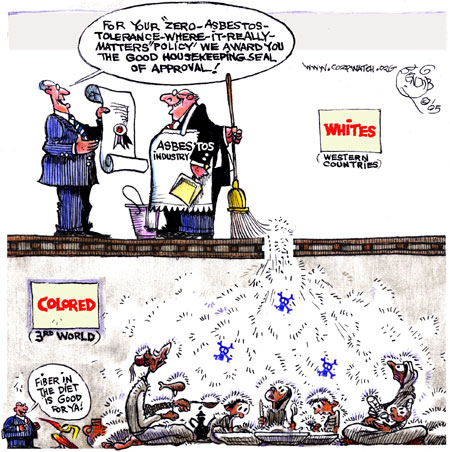
I am not against solar power, reduced emissions or higher efficiency. Obama's actions show a change from Bush. Is it progress? Of course. But, does it show a change in environmental thought? I just don't see his plan as particularly comprehensive, nor do I feel it to be as revolutionary as this article makes it sound.
It operates within the same general framework and political economy that sets up these power dynamics between developed and developing countries in the first place. No, I don't expect Obama to revolutionize the political economy (although he sure made out like that was his goal.)
The article doesn't mention Obama promoting attitudes about "the environment" as an issue of natural resource access/property relations, as an issue of racism and inequality, as a serious human health issue (Swine Flu!), which would be real change.
It touches on jobs, which is great, but it doesn't touch on the politics of food production and how factory farms are subsidized by the US government and our tax dollars. It doesn't discuss how industrial and chemical plants, and other environmentally hazardous industries, are disproportionately placed in minority neighborhoods, the neighborhoods of people with a weaker political and economic voice. It only seems to address issues of consumerism while ignoring the sociocultural constructs that allow these patterns.
It has a very top-down approach to "cleaning the air." Then again, he is the POTUS, so I don't know how he could do otherwise.
"The Climate won't wait..." Neither should Obama, and neither should we. I just think there are a lot of issues that Obama's plan doesn't look at as "environmental" that should be considered as such. Maybe it just hasn't come up yet (although, with swine flu, factory farms should come up!!)
It has indeed only been 100 days. Let's hope for more change.
Subscribe to:
Posts (Atom)